Political figures, human-rights advocates and organisations across the UK, Türkiye, the Muslim world, the United States and Europe are raising concern over Imran Khan’s treatment in custody following the latest account from his sister, Dr. Uzma Khan.
25 August 2026
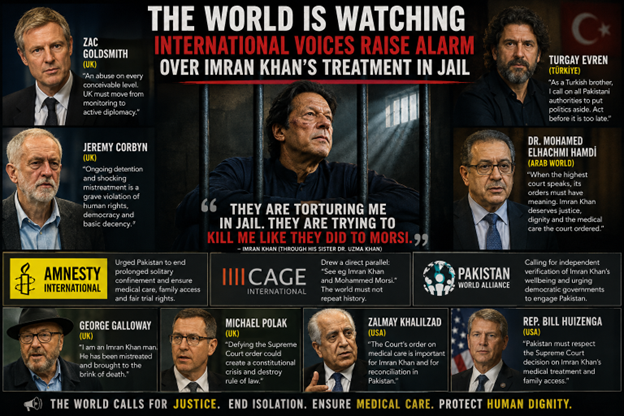
International concern over the imprisonment and treatment of former Pakistani Prime Minister Imran Khan has intensified following a disturbing account given by his sister, Dr. Uzma Khan, after she briefly met him during a medical examination.
At a press conference on 21 August, Dr. Uzma said Imran Khan repeatedly told her that he was being subjected to severe injustice, prolonged isolation and what he described as torture.
According to her account, Khan asked his family to tell the world:
“They are torturing me in jail. No human being can do to another human being what they are doing to me. They are trying to kill me like Morsi of Egypt.”
The reference was to former Egyptian President Mohamed Morsi, who died in 2019 after years of detention amid longstanding concerns over solitary confinement, restricted family contact and inadequate medical care.
Dr. Uzma also said that a doctor who examined Imran Khan had linked the deterioration in his health to a lack of meaningful human contact, prolonged isolation and resulting anxiety.
Her statement followed another controversy: Pakistan’s Supreme Court had ordered that Khan be examined at Shifa International Hospital by a multidisciplinary medical board, with his personal physician Dr. Faisal Sultan and Dr. Uzma associated with the examination. Instead, Khan was taken during the night to the government-run PIMS hospital and returned to Adiala Jail after a limited examination.
The Pakistani government rejects allegations of torture and medical neglect and maintains that Khan is receiving appropriate medical care and prison facilities.
But outside Pakistan, concern is increasingly being expressed by political figures, lawyers, academics and human-rights organisations.
Zac Goldsmith: Britain Must Move Beyond “Monitoring”
Former UK minister Lord Zac Goldsmith has emerged as one of the strongest international voices raising concern over Imran Khan.
Reacting to developments surrounding Khan’s treatment and medical access, Goldsmith described what was happening as:
“An abuse on every conceivable level.”
He urged the British government to move beyond simply monitoring the situation and use active diplomacy.
Goldsmith has also encouraged British citizens to contact their Members of Parliament and has warned that without meaningful international engagement, Khan’s life could be at risk.
His intervention is significant because he has consistently raised Khan’s imprisonment and treatment as a human-rights and democratic issue rather than simply a Pakistani domestic political dispute.
Jeremy Corbyn: “A Grave Violation of Human Rights”
Former British Labour Party leader Jeremy Corbyn has also issued a strong condemnation.
Corbyn described the:
“Ongoing detention and shocking mistreatment of Imran Khan”
as a:
“Grave violation of human rights, democracy and basic decency.”
He renewed his call for Khan’s release and has previously criticised his prolonged isolation and restrictions on fundamental rights.
The intervention from Corbyn adds another prominent British political voice to growing calls for scrutiny of Khan’s prison conditions.
George Galloway: “I Am an Imran Khan Man”
Veteran British politician and broadcaster George Galloway has been equally forceful.
Declaring:
“I am an Imran Khan man,”
Galloway has repeatedly spoken against Khan’s imprisonment and treatment.
Following growing concerns about Khan’s health and the intervention of Pakistan’s courts, Galloway argued that the authorities could no longer ignore the seriousness of the situation and warned of potentially grave consequences if Khan’s treatment continued.
His comments represent one of the strongest expressions of support from a prominent British political personality.
Michael Polak: Supreme Court Defiance Could Become a Constitutional Crisis
British barrister and international human-rights lawyer Michael Polak has focused specifically on the rule-of-law implications of Khan’s medical treatment.
Polak warned that failure to implement the Supreme Court’s directions concerning Khan’s hospital transfer and medical examination could create a constitutional crisis.
His argument goes beyond Khan personally.
If an order of Pakistan’s highest court concerning the health and treatment of a prisoner can be circumvented by executive authorities, he argues, it raises fundamental questions about judicial authority, constitutional government and the rule of law.
Daniel Hannan: Khan Represents Democracy and Rule of Law
British writer, politician and former Member of the European Parliament Daniel Hannan has also highlighted Imran Khan’s deteriorating situation.
Hannan has argued that Khan’s imprisonment should matter to Britain because Khan has come to represent broader principles of democratisation, political participation and the rule of law.
His intervention places Khan’s treatment within a wider debate over Pakistan’s democratic direction rather than seeing it simply as a dispute between competing political parties.
Türkiye: Growing Concern Over Khan’s Treatment
The comparison with Mohamed Morsi carries particular resonance in Türkiye, where Morsi’s imprisonment and death generated widespread public and political reaction.
Imran Khan also retains substantial recognition and goodwill in Türkiye, making the latest reports particularly sensitive.
Turgay Evren: “Act Before It Is Too Late”
Turkish writer and songwriter Turgay Evren, known for his work on humanitarian causes including Palestine and Kashmir, has repeatedly appealed for Khan to receive proper medical treatment.
Addressing Pakistani authorities as a “Turkish brother,” Evren urged them to:
“Put politics aside”
and ensure Khan received the medical care he required.
His central warning was stark:
“Act before it is too late.”
Following the controversy surrounding the Supreme Court-ordered hospital transfer, Evren continued amplifying concerns over Khan’s treatment and the circumstances surrounding his return to prison.
His intervention is especially significant because it reflects the growing humanitarian dimension of the issue in Turkish public discourse.
Özlem Doğan: The Morsi Parallel Was Already Being Raised in Türkiye
Turkish journalist Özlem Doğan had already drawn a direct comparison between the treatment of Imran Khan and Mohamed Morsi even before Dr. Uzma’s latest press conference.
She argued that the Muslim world risked abandoning Imran Khan to those persecuting him in much the same way that Mohamed Morsi had been left isolated.
Her comments are important because they demonstrate that the Morsi comparison was already resonating within Türkiye before Imran Khan himself reportedly invoked Morsi’s fate through his sister.
The comparison has therefore acquired even greater significance following Dr. Uzma’s account.
Voices From the Muslim World
Dr. Mohamed Elhachmi Hamdi: “Justice, Dignity and the Medical Care the Court Ordered”
Arab journalist, broadcaster and political figure Dr. Mohamed Elhachmi Hamdi reacted strongly to the reported failure to take Imran Khan to the hospital specified by the Supreme Court.
Hamdi stressed that when the highest court of a country issues an order, that order must have meaning.
He called for Khan to receive:
“Justice, dignity, and the medical care the court ordered.”
His statement is particularly important because it comes from a prominent Muslim and Arab public voice and focuses on the fundamental principle that political differences cannot override judicial authority or human dignity.
Dr. Abdullah Al-Amadi: Concern From the Gulf
Qatari writer, columnist and author Dr. Abdullah Al-Amadi has also expressed concern over Imran Khan’s imprisonment and health.
As reports emerged about the planned hospital transfer, Al-Amadi highlighted Khan’s endurance after years in prison and expressed hope for his recovery.
His reaction provides an important Gulf and Arab dimension to the international concern surrounding Khan.
Human-Rights Organisations Raise the Alarm
Amnesty International: End Prolonged Solitary Confinement
The concerns expressed by Dr. Uzma did not begin with her latest press conference.
Earlier in August, Amnesty International publicly called on Pakistani authorities to end Imran Khan’s prolonged solitary confinement.
The organisation raised concerns over restrictions on:
- meaningful human contact;
- access to family;
- access to lawyers;
- medical care; and
- fair-trial guarantees.
Amnesty called for his solitary confinement to end immediately and for adequate medical treatment and access to family and legal counsel to be restored.
Dr. Uzma’s latest account gives renewed urgency to those concerns because Khan himself is now reportedly saying that the lack of human contact and prolonged isolation are seriously affecting his health.
CAGE International Invokes the Morsi Comparison
UK-based human-rights organisation CAGE International has also placed Imran Khan’s imprisonment within the broader history of political detention and authoritarian repression.
In discussing political leaders targeted and imprisoned after challenging entrenched power structures, the organisation explicitly referenced:
“Imran Khan and Mohammed Morsi.”
The comparison has acquired new significance following Dr. Uzma’s statement that Khan himself fears he could face the same fate as Egypt’s former president.
Pakistan World Alliance Calls for International Verification
The Pakistan World Alliance, operating internationally, has called for democratic governments — particularly the United Kingdom — to seek independent verification of Imran Khan’s wellbeing.
The organisation has urged foreign governments to engage Pakistani authorities over:
- Khan’s medical care;
- his conditions of detention;
- restrictions on family access; and
- allegations of violations of his fundamental rights.
The organisation has also raised Khan’s case internationally, including before UN human-rights mechanisms.
Doctors for Imran Khan: Medical Examination Must Be Completed
The international group Doctors for Imran Khan expressed serious concern over what it described as an incomplete medical assessment following the Supreme Court order.
The group called for Khan to be taken to Shifa International Hospital and for the medical examination ordered by the Court to be completed properly and independently.
This medical intervention is particularly relevant because Dr. Uzma said Khan told her that doctors had already linked his deteriorating condition to prolonged isolation, anxiety and lack of human contact.
International Legal and Diplomatic Voices
Jared Genser: Supreme Court Should Consider Strong Action
International human-rights lawyer Jared Genser reacted to reports surrounding the alleged failure to implement the Supreme Court’s directions.
Genser said that if reports of non-compliance with the Court’s order were accurate, Pakistan’s Supreme Court should consider contempt proceedings and other measures capable of protecting Khan’s rights while his legal appeals remain pending.
His intervention raises a fundamental question:
What protection does a prisoner have if even an order of the country’s highest court cannot guarantee his medical treatment?
Zalmay Khalilzad: Medical Concerns Cannot Be Ignored
Former US Ambassador to the United Nations, Afghanistan and Iraq Zalmay Khalilzad has repeatedly raised concerns about Imran Khan’s imprisonment.
Khalilzad welcomed the Supreme Court’s intervention ordering medical treatment and described it as potentially important not only for Khan but for wider political reconciliation in Pakistan.
He has also questioned why medically necessary investigations or treatment were reportedly being delayed despite continuing concerns over Khan’s health.
US Congressmen Call for Compliance With the Court
US Congressman Bill Huizenga urged the Pakistani government to respect the Supreme Court’s decision concerning Imran Khan’s medical treatment and family access.
Congressman Jack Bergman publicly supported that position.
The involvement of sitting members of the US Congress adds another level to the international attention now being directed toward Khan’s treatment.
Why the Morsi Warning Has Changed the Debate
For months, international concern surrounding Imran Khan focused largely on:
- the legality and fairness of his imprisonment;
- prolonged solitary confinement;
- restrictions on family and lawyer access;
- political repression;
- medical concerns; and
- Pakistan’s democratic trajectory.
Dr. Uzma’s latest account has introduced something far more serious.
According to his sister, Imran Khan now believes his life itself is in danger.
His reported comparison with Mohamed Morsi cannot be treated lightly.
Morsi, Egypt’s first democratically elected president, spent almost six years in detention following his removal by the military.
Human-rights organisations repeatedly raised concerns over his isolation, medical treatment and prison conditions.
He collapsed during a court appearance in June 2019 and died.
After his death, the United Nations human-rights office called for a prompt, impartial and transparent investigation. Human Rights Watch said his death was “terrible but entirely predictable” given longstanding concerns over his treatment and access to medical care.
It is against this history that Imran Khan’s reported warning must be understood.
A Growing International Human-Rights Question
Pakistan’s government strongly rejects allegations that Imran Khan is being tortured or denied medical care.
It maintains that he has received repeated medical examinations, adequate facilities and appropriate treatment while in custody.
Those claims deserve to be placed on the record.
But they do not eliminate the questions now being raised internationally.
When the sister of a former Prime Minister emerges from a rare meeting and says that her brother has asked her to tell the world he is being tortured and fears he could be killed through the same kind of prolonged isolation associated with Mohamed Morsi, the matter moves beyond routine political controversy.
And when prominent political figures, lawyers, academics and human-rights organisations across several countries begin raising parallel concerns, the issue becomes increasingly difficult for the international community to ignore.
From Zac Goldsmith, Jeremy Corbyn, George Galloway, Michael Polak and Daniel Hannan in Britain, to Turgay Evren and Özlem Doğan in Türkiye, Mohamed Elhachmi Hamdi and Abdullah Al-Amadi from the Muslim world, Zalmay Khalilzad and members of the US Congress, and organisations including Amnesty International, CAGE International, Pakistan World Alliance and Doctors for Imran Khan, a common concern is emerging:
The world needs credible assurances that Imran Khan’s life, health and fundamental rights are being protected.
His reported message from prison could hardly be more serious:
“They are torturing me in jail. They are trying to kill me like they did to Morsi.”
The world has now been told.
The responsibility is to ensure that history is not allowed to repeat itself.